Venue Before Vision: How Youth “Volunteering” in Bangladesh’s Development Sector Quietly Became a Paid Appointment
There is a question that has started to precede almost every invitation to a youth engagement programme in Dhaka: venue kothay, TA/DA kotu? Where is it, and what does it pay? It is asked casually, almost automatically, before anyone asks what the programme is actually about. And it should give us pause — not because...

Articles On CARO’S Law
Law-1: Leadership and Vision “Respect and Learn From Leaders” Do you want to know how a leader actually develops? Then you need to know how to lead. And the most important way to learn that is to learn from experienced leaders. Because they have already faced various problems and solved them. If they know how...
UN Security Council Veto vs. UGF’s Weighted Voting in the GGC: Toward Greater Equity
Introduction The United Nations Security Council (UNSC), established in 1945, was designed to maintain international peace and security. Over time, however, its structure, particularly the veto power held by its five permanent members (P5: United States, United Kingdom, France, Russia, and China) has faced growing criticism. The veto is increasingly viewed as anachronistic, undemocratic, and...
Resilience: The Double-Edged Core of Political Survival
In political life, “resilience” is often presented as a cure-all,an admirable trait of leaders who weather storms, stabilize economies, and reassure anxious publics. Yet resilience is not an unambiguously noble quality, nor is it merely a matter of personal toughness. It is a political capacity: one that can either stabilize democracies or entrench power in...

CARO: Vision, Work and Philosophy
An escalating global crisis of governance characterizes the 21st century. In nations and societies, individuals increasingly believe that political regimes are no longer representative of them, that institutions do not safeguard equality, and that leadership is disconnected from accountability. There are elections, laws, and legal rights, but there is no justice; there is inequality, corruption,...
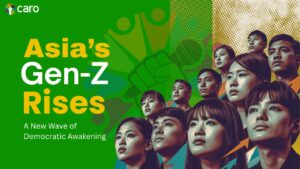
Asia’s Gen Z Rises Against Entrenched Political Elites: A New Wave of Democratic Awakening
Introduction Political transitions represent some of the most delicate moments in the life of a state. Whether facilitated by caretaker governments, interim regimes, or structured party handovers, these transitions determine not only the stability of electoral outcomes but also the resilience of democratic institutions. Scholars of comparative politics argue that the effectiveness of such transitions...

In What Ways Can Youth Reformers and Civic Actors Push for More Transparency and Accountability within Existing Structures
Transparency and accountability form the bedrock of effective governance and long-term sustainable development. In recent decades, youth reformers and civic actors have risen as dynamic forces championing integrity, ethical leadership, and citizen involvement. This paper investigates the diverse strategies employed by young reformers and civic organizations in Bangladesh and worldwide to bolster transparency and accountability...
From Historical Grievance to Pragmatic Engagement: Can Bangladesh and Pakistan Forge a New Path?
Abstract Bangladesh and Pakistan share a complex political history shaped by the events before and after the 1971 Liberation War. Although diplomatic ties exist, mistrust and unresolved historical issues continue to hinder cooperation. This article explores the challenges and opportunities for redefining the relationship through economic, geopolitical, and social collaboration, arguing that pragmatic incentives can...
IMF Loan Conditions and Their Impact on Vulnerable Economies
Abstract The International Monetary Fund (IMF) plays a central role in stabilizing economies experiencing balance-of-payments crises. However, its lending is tied to conditionality requiring borrowing countries to implement specific economic reforms. This article examines the evolution of IMF loan conditions and their impact on vulnerable economies. While IMF programs can promote macroeconomic stabilization and foster...
Fairness as a Meta-Norm: Structural Legitimacy and the Meta-Right to Fair Institutions
Political philosophy has long been preoccupied with the problem of legitimacy. Under what conditions may an institution claim moral authority over free and equal persons? Classical answers turn to the fairness of procedures, the justice of outcomes, or the moral acceptability of coercive rules under conditions of public reason. Rawls famously grounds legitimacy in principles...