About This Publication
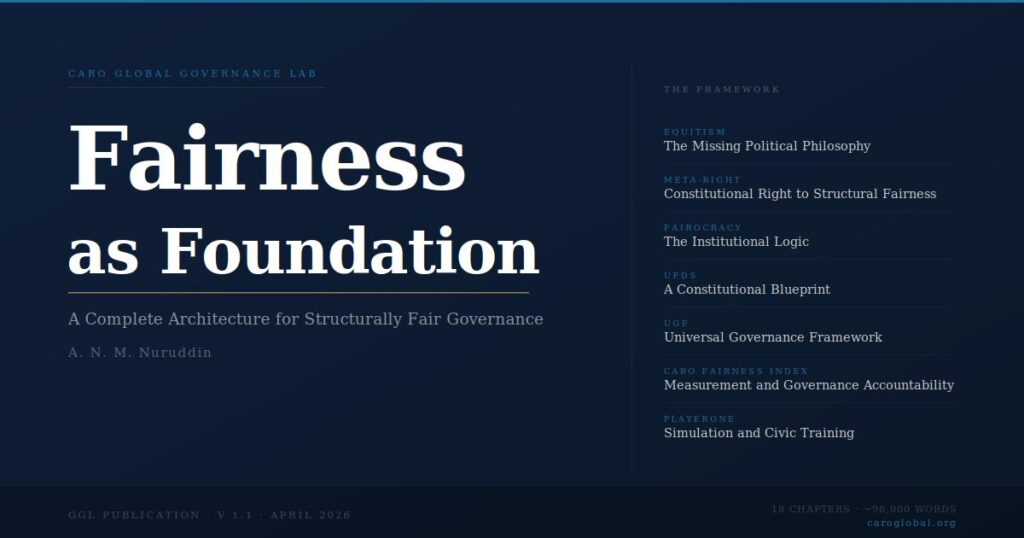
Fairness as Foundation: A Complete Architecture for Structurally Fair Governance is the first comprehensive statement of the framework CARO has been building since its founding — and the first major publication of the Global Governance Lab.
The book answers a question that eighteen years of political observation, comparative study, and philosophical inquiry produced: why do all democratic systems, at every stage of development and across every political culture, produce structural unfairness? Not because of bad leaders. Not because of weak civic culture. Because of how governance systems are designed.
The answer this book provides is architectural. Governance fails when it is structurally designed to fail — when authority and accountability are decoupled, when the governed are excluded from the justificatory processes that bind them, and when institutional architecture makes certain outcomes predictable regardless of who holds power. The response must be equally architectural: not reform of individual rules, but redesign of the structural conditions that produce governance outcomes.
The framework the book constructs moves through eight integrated layers:
Equitism — the political philosophy that establishes structural fairness as a design obligation, not an aspiration. The Meta-Right to Structural Fairness — the constitutional right that individuals hold against governance architectures designed to undermine their equal standing. Fairocracy — the institutional logic through which that right is enforced through governance design rather than individual virtue. The FairVote Protocol — the decision mechanism that aligns authority with accountability at the most fundamental level of democratic governance. The Unified Fair Democratic System (UFDS) — a complete constitutional blueprint for structurally fair democratic governance. The Universal Governance Framework (UGF) — the global extension of the framework to international institutions. The CARO Fairness Index — the measurement system through which structural fairness becomes empirically assessable and continuously monitored. PlayerOne — the simulation and civic training platform through which the framework is tested and taught before it governs.
Bangladesh serves as the primary diagnostic case throughout — the clearest available demonstration of how democracy dies through the law, and the context in which the framework’s first empirical application is underway. But the framework is not about Bangladesh. It is about every governance system that fails its people through design rather than through the failings of any individual actor.
This is the base document — the official intellectual foundation from which the framework will grow, be refined, be tested, and be implemented. It is not the final word. It is the first comprehensive one.
Full text is available to read below. Download the complete manuscript using the link
Publication Details
Author: A. N. M. Nuruddin — Founder & President, CARO Published by: CARO Global Governance Lab Version: V1.0 — April 2026 Pages: 18 chapters, 4 appendices, approximately 98,000 words Category: Political Philosophy / Governance / Institutional Design / Comparative Politics